The blizzard that descended upon northern Michigan on January 17th was the kind of atmospheric violence that rewrites local history. It was a whiteout so absolute that the distinction between the sky and the frozen earth vanished entirely. In the middle of that swirling chaos, my 91-year-old mother, Ruth, was a ghost in the making—a ninety-pound woman with four-foot-ten of fragile bones and a mind clouded by the fog of dementia. That night, she was saved by a man named Derek, a tattooed biker who carried her through the drifts when her own flesh and blood had essentially left her to die.
My name is Michael. Eight years ago, I relocated to the sun-drenched comfort of Florida, ostensibly for a fresh start. In reality, I was fleeing. I was exhausted by the relentless demands of a parent’s decline—the midnight phone calls, the repetitive questions, and the slow, agonizing erosion of the woman who raised me. I convinced myself that placing her in a high-end assisted living facility in Michigan was the “noble” choice. My brother, Tom, lived only twenty minutes from that facility, which gave me the moral alibi I needed to sleep at night.
The crisis began with a simple fall. The facility called Tom to report that Mom needed X-rays. Tom, a man who viewed his mother as an administrative burden, claimed he was “entrenched in meetings” and told the staff to handle it. When they informed him of an $800 non-emergency ambulance fee, he balked at the cost and called me to vent about the “extortion.” I was at a restaurant in Florida, the clinking of glasses and the warmth of the humid air making the Michigan winter feel like a distant myth. I told him to do what he thought was best and hung up.
The facility eventually opted for a budget transport van to take Mom to an urgent care clinic three miles away. The driver, assuming family would be there to meet her, dropped her off and disappeared into the snow. For six hours, Ruth sat in a sterile waiting room in her slippers and a thin knit sweater. She was confused, cold, and utterly alone, telling every staff member who passed that “Tommy” was on his way with her coat.
By 7:00 p.m., the clinic was closing. The staff was frantic. They called Tom; he didn’t answer. They called me; I saw the Michigan area code on my phone screen and intentionally declined it, choosing to finish my wine rather than face another “problem.”
That was when Derek walked in. He was a mountain of a man, clad in salt-stained leather and heavy boots, stopping to check the weather reports before heading further north. He saw a tiny, elderly woman huddled in a plastic chair, weeping silently. When he asked if she was alright, she looked up with wide, watery eyes and said, “My son is coming. Tommy promised.”
The receptionist, her voice trembling with frustration, explained the situation: Ruth had been abandoned by her family, and the clinic could not keep her overnight. Outside, the temperature had plummeted to nineteen degrees, and the wind was howling with a predatory ferocity. Derek, a man with no obligation to this woman, tried to bridge the gap. He called Tom four times and me twice. We both let him go to voicemail.
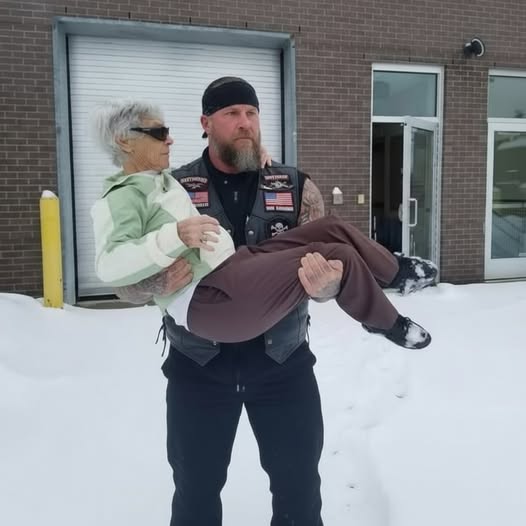
Derek looked at the tiny woman in the slippers and made a choice that neither of her sons was willing to make. He asked for the address of her assisted living facility—3.2 miles away through knee-deep snow—and simply said, “I’ll get her home.”
He wrapped his heavy leather jacket around her, swaddling her like a child. He lifted her into his arms and stepped out into the teeth of the blizzard. The walk was a nightmare of ice and endurance. The wind cut through his clothes like a blade, but he kept moving, talking to her the entire time to keep her from slipping into a hypothermic stupor. He told her about his motorcycle and his children; she told him about the “good boys” she had raised, unaware that those same boys were currently ignoring her existence from the comfort of their heated homes.
Halfway there, a patrol car spotted the strange silhouette of a giant man carrying a bundle through the storm. The officer helped them into the cruiser and drove the remaining distance. When they arrived at the facility, Derek was a frozen statue, his beard matted with ice, his body shaking with exhaustion. He refused medical attention for himself, ensuring only that Ruth was whisked away to a warm bed.
The director of the facility called me at 9:00 p.m. This time, a cold intuition made me answer. Her voice wasn’t just professional; it was scathing. She recounted the fall, the hours of waiting, the abandonment, and the biker who had walked three miles through a life-threatening storm to save a woman who wasn’t his.
The shame hit me like a physical blow. I spent the next hour vomiting in my bathroom, the bile a physical manifestation of my own cowardice. I flew to Michigan the next morning. My mother was alive, though her fingers were tipped with frostbite and her hip was a deep shade of purple. When I finally tracked down Derek’s number and called him, I started to offer a scripted “thank you.”
He didn’t let me finish. “You should be ashamed,” he said, his voice flat and hard. “That woman carried you for nine months and gave you a life. And you couldn’t be bothered to pick up a phone. Do better.” The line went dead.
I drove to his house the following day with a $5,000 check, desperate to buy back some shred of my dignity. He looked at the check and then back at me with a look of pure, unadulterated pity. “Take care of your mom,” he said, refusing the money. His wife stood beside him, her eyes cold. “My husband almost froze to death because you weren’t there,” she said. “He’d do it again, because he has a soul. What’s your excuse?”
I moved Mom to Florida within a week, paying every penalty and fee required to get her into a facility five minutes from my house. I visit her every single day now. Tom and I no longer speak; the bridge of our brotherhood was burned in the Michigan snow.
Derek still visits whenever he rides through the south. Mom doesn’t remember the blizzard, and she doesn’t remember the man who carried her, but she lights up when he enters the room. She often tells him he looks like her father. He just smiles and tells her it’s an honor.
I once asked him why he did it—why risk his life for a stranger when her own sons wouldn’t? He looked at me as if the answer were written in the sky. “Because she needed help,” he said. “Because she mattered.”
I will spend the rest of my life trying to reconcile the man I was with the man Derek taught me to be. He is a tattooed, leather-clad biker—a man the world often judges at a distance. But in a world of “good sons” who don’t answer the phone, he was the hero who walked through hell. He carried my mother through a storm, but in doing so, he carried my soul out of the wreckage of my own failure.