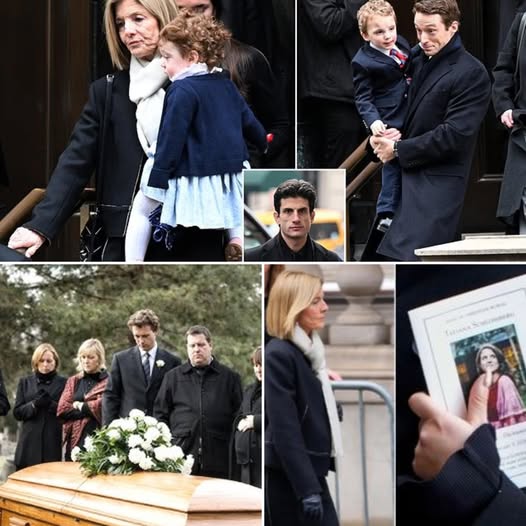
The winter morning in Manhattan carried a biting chill, but the air around the Church of St. Ignatius of Loyola on the Upper East Side was heavy with a stillness that transcended the weather. On January 5, 2026, the iron gates of the historic church opened to receive a gathering of the Kennedy and Schlossberg families—a lineage inextricably woven into the fabric of American history—who had come to perform the most agonizing of human rites: saying a final goodbye to a young mother, a brilliant writer, and a beloved daughter.
Caroline Kennedy, the former United States Ambassador and the last surviving child of President John F. Kennedy, walked toward the stone steps with a stoicism that has become her trademark. In her arms, she held her young granddaughter, a poignant image of the cycle of life continuing even in the shadow of profound loss. Beside her stood her husband, Edwin Schlossberg, and their children, Jack and Rose. They were joined by a small, somber circle of friends and dignitaries, including former President Joe Biden, who arrived quietly to offer his respects to a family that has endured more than its fair share of public and private tragedy.
The occasion was the funeral of Tatiana Schlossberg, who passed away on December 30, 2025, at the age of thirty-five. Her death followed a brief but fierce battle with acute myeloid leukemia, a diagnosis that had struck with the suddenness of a summer storm. In the weeks preceding her death, Tatiana had penned a deeply moving essay, a final gift to those she left behind. In her writing, she stripped away the veneer of her famous surname to speak with raw, human clarity about the terror of a life-threatening illness. She wrote of the grueling treatments that left her depleted, the bittersweet ache of watching her children play while she contemplated an uncertain future, and the profound, anchors-deep love she held for her husband and her family.
The choice of St. Ignatius of Loyola for the service added a layer of historical resonance to an already emotional day. It was within these same vaulted walls in 1994 that the world gathered to mourn Tatiana’s grandmother, Jacqueline Kennedy Onassis. The echoes of the past seemed to linger in the incense and the organ music, a reminder of the enduring resilience of a family that has often been forced to grieve in the eyes of the world. Yet, despite the presence of high-profile guests and the watchful eyes of the press from a respectful distance, the service was a deeply intimate affair, focused not on the weight of a dynasty, but on the vibrance of a woman who had forged her own distinct path.
Tatiana Schlossberg was never a woman defined solely by her ancestors. She was a woman of formidable intellect and a sharp, inquisitive pen. As an environmental journalist for The New York Times and other prestigious publications, she had dedicated her career to articulating the complexities of climate change and the urgent need for ecological stewardship. Her writing was characterized by a rare combination of scientific rigor and accessible, human storytelling—a voice that was just beginning to reach its full resonance when it was prematurely silenced.
Inside the church, the focus remained on the small family she left behind. Her husband, Dr. George Moran, sat with their two young children: Edwin, only three years old, and Josephine, barely a year old. The sight of the toddlers, largely unaware of the gravity of the moment, served as a heart-wrenching reminder of the primary tragedy of Tatiana’s passing. She was a mother at the dawn of her parenting journey, a woman whose life was centered on the small, daily miracles of raising a family.
The eulogies delivered during the service painted a portrait of a woman who was “cherished and unforgettable.” Those who spoke did not focus on the headlines or the history books, but on the quiet moments that truly define a life: Tatiana’s quick wit, her unwavering dedication to her craft, her love for the natural world, and the fierce protectiveness she felt for her children. They spoke of a woman who was a “light in the room,” someone who carried the weight of her family’s legacy with grace, but never let it obscure her own identity.
As the service concluded and the family emerged into the grey Manhattan light, there was a visible sense of collective strength. The Kennedy family has long been a symbol of American resilience, and in the wake of Tatiana’s death, they have once again retreated into a circle of mutual support. In a statement released shortly after her passing, the family pledged to keep Tatiana’s memory alive, ensuring that Edwin and Josephine grow up knowing the character, the intelligence, and the immense love of the mother they lost too soon.
The loss of a thirty-five-year-old in the prime of her life is a tragedy that defies easy explanation or comfort. Yet, in the legacy of her writing and the lives of her children, Tatiana Schlossberg leaves behind a testament to a life lived with purpose and deep affection. The environmental causes she championed and the stories she told will continue to influence readers, while her family will carry the flame of her spirit through the years to come.
As the funeral procession moved away from the Upper East Side, New York City continued its restless motion, indifferent to the quiet mourning of one family. But for those inside St. Ignatius that morning, the world had changed irrevocably. They had said goodbye to a woman who represented the best of her generation—a person of integrity, heart, and hope. In the quiet resilience of Caroline Kennedy, the grief-stricken resolve of George Moran, and the innocent play of two small children, the story of Tatiana Schlossberg remains unfinished, its chapters to be written in the love and remembrance of those who knew her best.